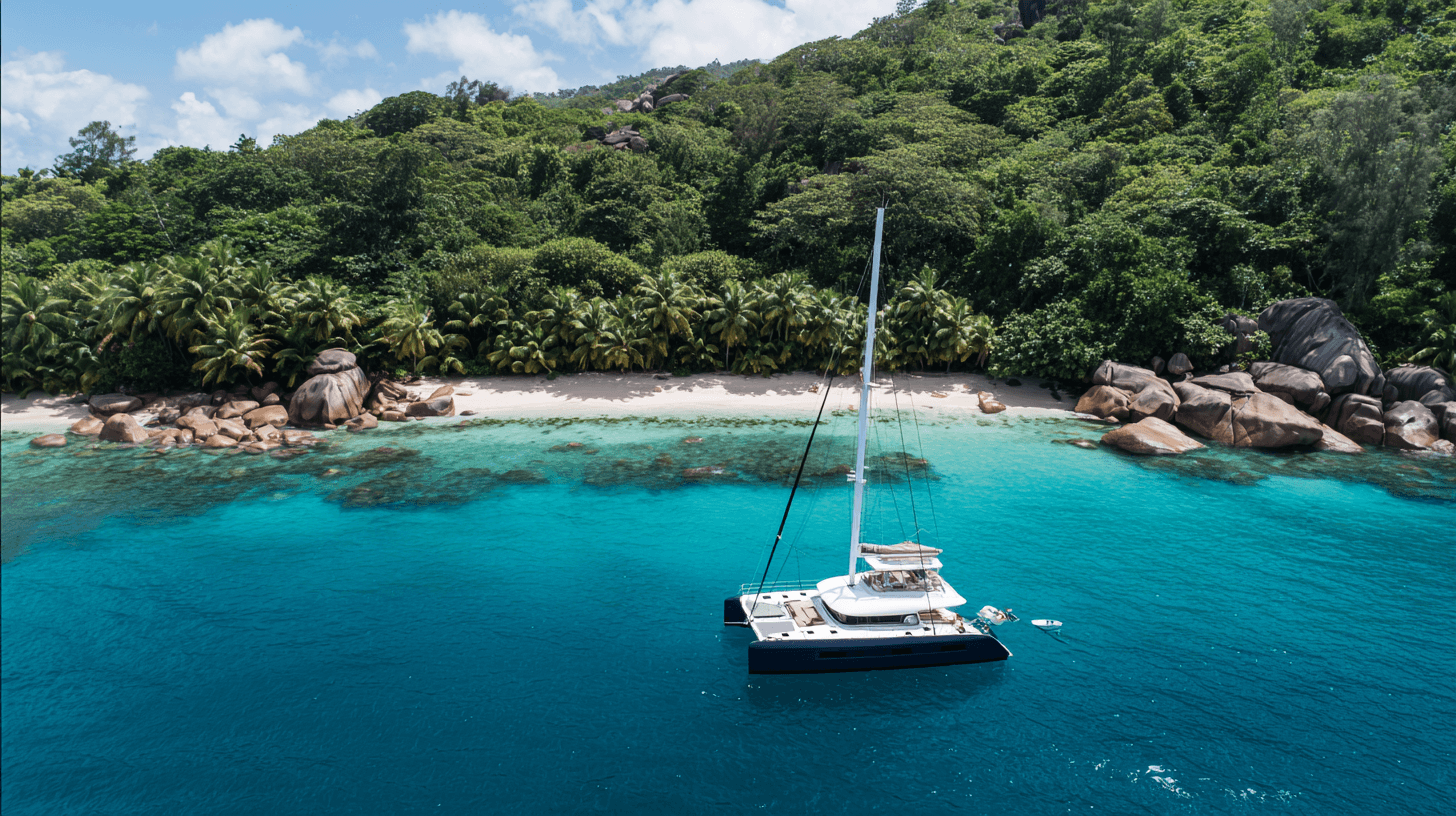
SeaNet Europe publishes its live co-ownership inventory in a way almost no competitor does, listing the exact fraction of each hull that is currently for sale. The sizes on offer run 15 percent, 16.67 percent, 17.77 percent, 20 percent, 22.22 percent, 25 percent, 33.33 percent, 35 percent, 50 percent and 100 percent, spread across Benetti and Pichiotti vessels. That list is a more honest description of the fractional market than any brochure, because it shows what is really being sold: not a portfolio, not a strategy, but a named percentage of one specific hull, alongside a small number of other people who each own a named percentage of the same hull.
What a Fraction Actually Is
Fractional ownership, syndication, co-ownership and yacht timeshare are commonly discussed as if they were four different products. Structurally they are variants of one arrangement with the same skeleton. A group of buyers, usually between three and ten, acquires a single vessel. Each holds either an undivided proportional interest in the hull itself or a contractual right against a company that owns the hull. Running costs are apportioned by share size. Usage is allocated by a calendar. A manager is appointed to handle the parts nobody wants to do. The variations concern only how the interest is papered and whether usage weeks are fixed or floating.
Yacht Share Network, which operates one of the more clearly documented programmes, sets out the mechanics plainly: between four and ten equity shareowners per yacht, each receiving between three and twelve weeks aboard per year, with running costs divided strictly pro rata by share size. A twelve-week owner contributes triple the maintenance of a four-week owner, receives triple the usage, and gets triple the weight in selection. Weeks are allocated by a serial rotational draft, with the order reversed the following year so that the owner who picked last this season picks first next season.
That rotational draft is worth pausing on, because it is the mechanism that reveals what the product is. A great deal of design effort has gone into the fair distribution of a scarce, seasonal, non-fungible thing: specific weeks aboard a specific boat. No comparable effort goes into the distribution of cash, because in most fractional structures there is very little cash to distribute. The asset is not producing income for the owners. It is producing holidays.
This is the single most important distinction between a fractional share and a pooled investment fund, and it survives every other comparison. A fractional share is a consumption asset with a financial wrapper. A fund interest is a financial asset with no consumption component at all. Everything that follows, on governance, on exit, on valuation, is downstream of that one difference. The two structures are not competing products dressed differently. They answer different questions, and a reader who is clear about which question they are asking will usually find the answer obvious.
The vocabulary muddies this. Yacht timeshare typically conveys a right to use without any interest in the vessel, which removes the owner from both the upside and the liability of the hull. Syndication normally implies genuine co-ownership, often through a special purpose vehicle. Fractional ownership, as marketed by the larger operators, sits closer to syndication with a professional manager bolted on. But a buyer evaluating any of the three is evaluating the same underlying proposition: shared access to one depreciating vessel, shared exposure to its costs, and shared dependence on the conduct of a small number of co-owners.
Where the Structure Holds
The case for fractional ownership is stronger than its critics usually allow, and the most articulate version of it comes from an operator. Matty Zadnikar, chief executive of SeaNet, described the problem his product is designed to solve in an interview with SherpaReport: when buying a yacht in the ten to fifty million dollar range, "it can lose much of its value, 40 to 50 percent over time, often just that much in the first year", while "the management costs are often 10 percent of its value", and "after the yacht is purchased, the yacht is sometimes used only 4 to 5 weeks a year."
Read that as an indictment of whole ownership rather than a sales pitch and it is difficult to argue with. A buyer who uses a vessel for five weeks a year is paying the full depreciation and the full operating cost base of an asset that sits idle for eleven months. Dividing that hull four ways, so that four households each take a season's worth of use and each carry a quarter of the carrying cost, is a straightforwardly rational response. SeaNet claims reductions of up to 75 percent in both initial purchase price and annual operating cost relative to whole ownership, which is an operator marketing claim rather than an audited figure, but the direction of travel is not in dispute.
Fractional ownership also delivers something no pooled vehicle can replicate, and it is not a trivial thing. The owner has a boat. It is a particular boat, with a particular tender, a particular crew who learn the family's preferences, and a particular berth. Personal effects can stay aboard. The vessel can be specified at build. For a buyer whose objective is to spend time on the water with people they care about, this is the entire point, and no financial structure that removes it can be a substitute for it however elegant the waterfall.
The third genuine advantage is control over the decision that matters most, which is the choice of asset. A fractional buyer inspects the specific hull, reads its specific survey, and knows exactly what they are buying. A fund investor commits capital to a manager's future decisions and receives, at best, a stated acquisition policy. That is a real transfer of discretion, and a sceptical allocator should treat it as a cost of the fund structure rather than pretend it away.
Fractional ownership is therefore the correct answer for a reasonably large class of buyers: those who want to use a yacht for more than a fortnight and less than a season, who can tolerate a five to seven year holding period, who are not relying on the capital coming back, and who are comfortable with the specific people they are buying alongside. For that buyer, comparing a fraction to a fund is a category error. The fraction is not an inferior investment. It is not an investment at all, and it should not be evaluated as one.
The Governance Problem
Where the structure begins to break is not the asset. It is the constitution. A fractional group is a small, undiversified partnership with no chief executive, no casting vote, and no defined term, holding an asset that generates a continuous stream of decisions requiring money. The failure modes that follow are predictable enough that they recur in near-identical form across two decades of owner accounts.
The most useful record of them is not a research report but the archive of the YBW forums, where British owners describe their own syndicates in unsparing terms. One contributor to a long-running thread on yacht share pitfalls put it as directly as it can be put: shared ownership is, in his experience, "the best way to ruin a friendship." He describes the pattern rather than the incident. "In the first year all seems to go well but from then on rifts start to appear as to who's doing or done what and who should pay for what." On larger vessels, he adds, "no one seems to have taken on-board the amount of money necessary to keep the boat up to the required MCA standard and invariably the syndicate gets into trouble and the boat is sold off at a loss." Another contributor to the same thread describes two lifelong friends who "became completely estranged over co-ownership." This is attributed lived experience rather than data, and should be read as such, but its consistency across unrelated posters is itself informative.
Two specific mechanisms recur. The first is the unequal-effort problem, expressed in the thread as the observation that the most practical member of the group ends up spending most of his weekends fixing the boat while the other four enjoy it. Nothing in a pro-rata cost split addresses this, because the contribution being unequally supplied is labour and attention, not money. The second is what might be called the damage-then-lost-turn cascade: "the last one to use it does some damage and the boat has to come out of the water so the next in line loses his turn", described by the poster as "an absolute minefield." The economic loss is small. The relational loss is not, and it is the relational loss that ends syndicates.
The revealing point is how the better operators respond to this. SeaNet's answer, described in the SherpaReport interview, is to eliminate co-owner governance entirely. Co-owners sign a non-disclosure agreement requiring all communication to route through SeaNet, and there is no contact between them at all. The company's stated position is blunt: "We are not interested in making new friends." Its preferred group sizes are three or four owners.
That is a serious and defensible design, and it deserves to be recognised for what it is. It is an admission, by the most sophisticated operator in the segment, that peer governance of a shared vessel does not work, and that the only reliable fix is to insert a professional manager with authority and to prevent the owners from having to negotiate with one another. Once that concession is made, the remaining question is no longer whether a manager should hold operational authority. It is what the owners are left holding, and whether the instrument they hold gives them any way out.
Exit, Valuation and Probate
The exit is where the fractional structure is at its weakest, and the language operators use around it is worth reading closely. SeaNet's published position on what happens when circumstances change is that "if your plans change, your share is fully transferable." That is a true statement about the legal character of the interest. It is not a commitment to buy the share, not a commitment to find a buyer, and not a statement that a buyer exists. Transferability and liquidity are different properties, and in this market the gap between them is the whole problem.
The gap exists because a fractional share has no reference price. A whole yacht can be valued against comparable sales, brokerage listings and survey condition. A fraction of a specific hull, carrying a specific usage calendar, a specific management agreement, a specific co-owner group and a specific set of unfunded future maintenance obligations, has no comparable at all. Pricing is therefore bilateral, and bilateral pricing between one motivated seller and a very thin pool of possible buyers does not favour the seller. Nothing in the structure creates a market maker, because there is no fee stream that would pay for one.
The starkest illustration of what illiquidity means in practice is what happens when an owner dies. A February 2024 discussion on the YBW forums, prompted by exactly this question, sets out the trap with some legal precision. The surviving co-owner "could sell their share but might find it difficult to find a buyer", and the estate's own sale "may only be possible when the executor or administrator of the estate is confirmed in office by a grant of probate." The vessel does not stop costing money while probate runs. The contributors also flag a distinction most syndicate buyers never consider, between joint tenancy and tenancy in common: where a vessel is held jointly across all sixty-four shares, "the heirs of the dead owner get nothing." The suggested workaround, holding the vessel through a company, is acknowledged in the same discussion to bring "more administration, more costs and, perhaps, more tax", feasible on a boat worth more than a million pounds and not worth it below a hundred thousand. The thread's closing advice is two words: "Or just steer clear."
The scale evidence points the same way. Robb Report, in an examination of why fractional yachting has never achieved the penetration of fractional aviation, contrasts a United States business aviation fractional fleet of roughly 830 aircraft with a yachting market of "fewer than two dozen fractional vessels, most under 70 feet, owned by only a couple of companies", of which only six are superyachts over 100 feet. The piece carries no visible publication date and its internal references place it around 2022 to 2023, so it should be treated as directional rather than current. But the operators quoted in it are unambiguous. Vincenzo Poerio, chief executive of Tankoa Yachts, calls fractional "a logical business model that gets an illogical reaction from the yachting community", adding that "most yacht owners don't like to share." Filippo Rossi of Floating Life is blunter: "It will always be a niche. Fractional will never revolutionize yachting."
The reason the aviation analogy fails is given by Patrick Gallagher, president of NetJets, and it is an operating point rather than a cultural one. Business aviation "has the mix of business and leisure that complement each other" and offers "guaranteed access year-round, while demand in yachting seems much more seasonal." Fractional aviation works because the underlying asset is used continuously by different constituencies with different needs. A yacht in the Mediterranean is wanted by everybody in the same eight weeks and by nobody in November. Two documented programmes illustrate what that does to a business: Floating Life launched with three Norman Foster-designed sisterships around 2010 and only one remains, while its planned Dream 42 secured three of the seven required signees and could not begin construction; AvYachts entered fractional ownership in 2017, sold its Westport 130 and Westport 112, and retreated to brokerage matchmaking.
The Case Against Pooling
An honest comparison has to state what a pooled fund gives up, and the answer is almost everything the fractional buyer came for. There is no boat. There is no calendar. There is no crew who know the family. A limited partnership interest in a diversified vessel portfolio confers no right to step aboard anything, and any investor whose motivation is partly experiential should stop reading at that point and buy a fraction, because the fund cannot deliver what they want at any price.
The second concession is harder, and it applies to every illiquid real asset in the current environment rather than to yachts specifically. The risk-free real return is no longer zero. The market yield on ten-year inflation-indexed United States Treasury securities stood at 2.44 percent on 17 August 2026, according to the Federal Reserve's H.15 release as published by the St. Louis Fed. That is a liquid, daily-priced, inflation-protected real return available with no operational drag, no manager, no crew, no berth, no insurance renewal and no illiquidity. Any pooled real-asset structure must clear that hurdle after its entire operating cost base and after a discount for the years during which the capital cannot be recalled. In 2021 the hurdle was effectively zero and a great many private structures were interesting by default. It is not zero now, and there is no clean rebuttal to that point. Capital committed to any such vehicle is at risk, and returns are targeted rather than promised.
The long-run record of luxury real assets does not soften the picture either. Knight Frank's Luxury Investment Index, which tracks ten collectable categories including art, watches, cars, wine and jewellery, closed 2025 down 0.4 percent after falls of 2.7 percent and 3.3 percent in the two preceding years, and has risen 38.6 percent over the past decade, an annualised nominal rate of roughly 3.3 percent. Against the inflation of that decade, that is approximately flat in real terms. It is worth stating plainly that yachts are not among the ten categories Knight Frank tracks, so this is context rather than a yacht price series, and no verified institutional yacht value index exists. But an investor who assumes that luxury hard assets have historically compounded wealth is working from an impression rather than an index.
The third concession concerns discretion. A fractional buyer selects the hull. A fund investor selects a manager and then lives with that manager's acquisition, deployment and disposal decisions for the life of the vehicle. Blind-pool risk is real, manager selection is the dominant variable, and the fee load sits between the asset's gross cash flow and the investor's net return in a way that a directly held fraction avoids entirely. An allocator who does not have a view on the manager should not have a view on the fund.
The honest summary is therefore narrower than the marketing on either side. Fractional ownership is a good answer to a consumption problem and a poor answer to an allocation problem. A pooled structure is a plausible answer to an allocation problem and no answer at all to a consumption problem. The mistake that costs people money is buying a fraction while telling themselves it is an investment, and then discovering at the point of exit that the instrument was never designed to be sold.
What a Fund Structure Changes
If the failures catalogued above are read carefully, almost none of them are asset failures. Deadlock over a repair, unequal effort, a lost turn after damage, an estate frozen by probate, a share with no buyer: each is a failure of constitution, not of hull. Yachts do generate charter revenue and yachts do depreciate, and neither of those facts is altered by ownership structure. What a limited partnership supplies is the missing constitution, and it supplies it in four specific places.
It supplies a manager with defined authority, so that operational decisions are made once rather than negotiated among owners, which is precisely the conclusion SeaNet reached from inside the fractional model. It supplies a defined term, so that the exit is a scheduled event contemplated at the outset rather than a bilateral search conducted under pressure. It supplies diversification across multiple hulls, cruising grounds and charter seasons, so that a single engine failure, a single hurricane track or a single weak season is an incident rather than an existential event. And it supplies a distribution waterfall, so that the order in which cash reaches the parties is documented before any cash exists, rather than argued about afterwards.
| Dimension | Fractional share | Pooled fund interest |
|---|---|---|
| Instrument | Direct co-ownership of one hull | Limited partnership interest in a Cayman Islands Exempted Limited Partnership |
| Decision making | No chief executive and no casting vote | A manager with defined authority, so decisions are made once |
| Term | No defined term | A defined term, so exit is a scheduled event |
| Exit pricing | No reference price, bilateral between one motivated seller and a thin buyer pool | Governed by the documented distribution waterfall |
| Probate | Can freeze a sale entirely | Interest transfers under the partnership terms |
| Concentration | One hull, one cruising ground, one season | Multiple hulls, cruising grounds and charter seasons |
| Right of use | Weeks aboard a specific vessel | None, it confers no right to step aboard anything |
At HelmShare, that structure is HelmShare Prime Fund, L.P., a Cayman Islands Exempted Limited Partnership issuing limited partnership interests. The General Partner and Investment Manager is HelmShare LLC, incorporated in the DIFC and an applicant for a DFSA Category 3C licence and not yet licensed. Interests are offered outside the United States in reliance on Regulation S, to EU and EEA professional investors and to United Kingdom and Gulf high net worth and qualified investors. United States persons are excluded. Returns are targeted rather than promised, capital is at risk, and past performance of any comparable asset is not a guide to what the Fund will achieve. Where the Fund's charter partner Navigare has given an eight percent yield commitment, that commitment is contractual and runs to the Fund, not to investors, and it does not convert into any assurance about what investors receive.
None of that makes a pooled structure the right choice for every reader, and the analysis above is not intended to produce that conclusion. For a household that wants to be on a specific boat for six weeks a year, a well-drafted fractional agreement with a professional manager and a realistic view of the exit is the better instrument, and the honest advice is to buy one and enjoy it. For an allocator looking at yachting as a source of contracted cash flow, the fractional structure is the wrong wrapper for the exposure, because it delivers governance risk, concentration risk and exit risk that the underlying charter economics never required anyone to take.
The distinction worth holding onto is simply this. A fraction is an undivided interest in one depreciating hull with a bilateral exit and a committee for a board. A pooled fund is a diversified interest across a fleet with a defined term, a manager with authority and a documented waterfall. Both are legitimate. They are not, however, alternatives to one another, and the reader who is clear about which of the two problems they are trying to solve will not need anyone to tell them which one to choose.
References
1 SeaNet Europe. "Co-Ownership: Custom Yacht Ownership." Live share inventory, accessed 2026.
https://seanet.eu/custom-yacht-ownership/co-ownership/
2 SherpaReport. "Yacht Co-Ownership with SeaNet." Interview with Matty Zadnikar, 17 November 2022, updated 17 July 2026.
https://www.sherpareport.com/boats/yacht-co-ownership-seanet.html
3 Yacht Share Network. "How It Works." Programme terms, accessed 2026.
https://www.yachtshare.com/how-it-works/
4 Robb Report. "Why Fractional Yachting Isn't Popular." Undated feature, internal references place it circa 2022 to 2023.
https://robbreport.com/motors/marine/why-fractional-yachting-isnt-popular-1234773114/
5 YBW Forums. "Yacht Share Pitfalls and Advantages?" Owner discussion thread. Attributed anecdote, not survey data.
https://forums.ybw.com/threads/yacht-share-pitfalls-and-advantages.87001/
6 YBW Forums. "Shared Ownership." Owner discussion thread, started 1 February 2024. Attributed anecdote, not legal advice.
https://forums.ybw.com/threads/shared-ownership.605390/
7 Board of Governors of the Federal Reserve System. "Market Yield on U.S. Treasury Securities at 10-Year Constant Maturity, Inflation-Indexed (DFII10)." H.15 Selected Interest Rates, observation for 17 August 2026, retrieved from FRED, Federal Reserve Bank of St. Louis.
https://fred.stlouisfed.org/series/DFII10
8 Knight Frank. "The Knight Frank Luxury Investment Index: Luxury Holds Steady." The Wealth Report 2026, 23 April 2026.
https://www.knightfrank.com/research/article/2026/4/knight-frank-luxury-investment-index-luxury-holds-steady
Interested in yacht investments?
Professional, qualified and high net worth investors outside the United States who want to examine the structural detail, including the term, the fee waterfall and the eligibility criteria, can request the Fund documentation for HelmShare Prime Fund, L.P. Capital is at risk and all returns are targeted rather than promised.